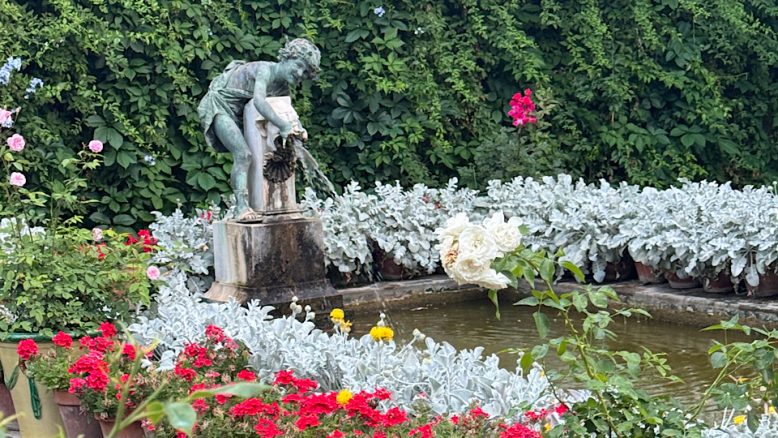
In the courtyard a garden is preserved like a monument. Labyrinth hedges and tree pruned tea roses. The statues pause to circulate the water. The colours of foreground and background blend and conform to traditional views of the relationship between persons and creation. The maiden gardens invite us to revisit the first garden.
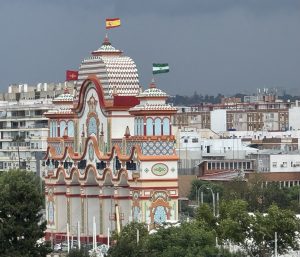
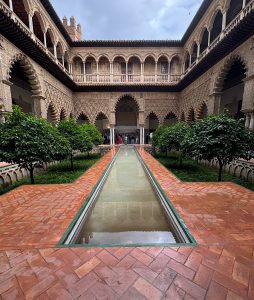
The play-spaces in Seville are gated in Arabic glitter. Yet in the formal gardens attention to poly lubed arches marks a 14th century love for geometric detail. The shaded walkways in a city where summer temperatures can exceed forty degrees is a human consideration that reaches beyond design. The water fountains and hedges further moderate the extremes of temperature. In the palace courtyard a recent excavation has uncovered a sixteenth century garden that depicts the garden of Eden as two parallel plantings that provide the knowledge of living with good around evil and the knowledge of life. The cooling stillness of the water walks between the trees. In the heat of the day the water chills the breeze so the cloistered voices can be heard.
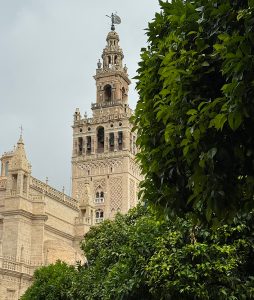
History has a way of superimposing the marks of the beast of conquest on the conquered. The minaret of the mosque in Seville was shored with flying gothic buttresses and topped with bells as it turned to call the faithful to the largest church in Europe. The Cathedral stands as invitation to the faithful. A monument to the generations of living together. Of crossing rigid lines.
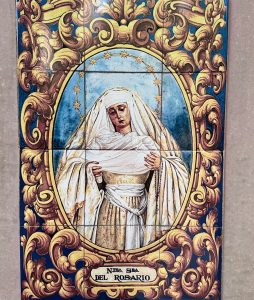
In the shadows of the cloister walk an image of Hermania in tiles collected by the Duchess of Alba and displayed to honour her skills in Flamenco dancing, Equestrianism, Art and Paining, Cultural Preservation, Languages (Aside from Spanish she spoke English, French, German, and Italian fluently). She was known as the rebel noble. In the maiden gardens the images of the duchess move beyond invitation to a rebellion that may spade the garden of Eden for a new crop.