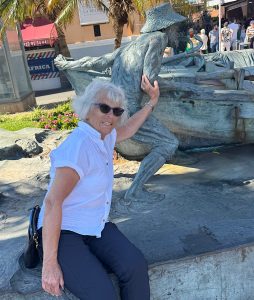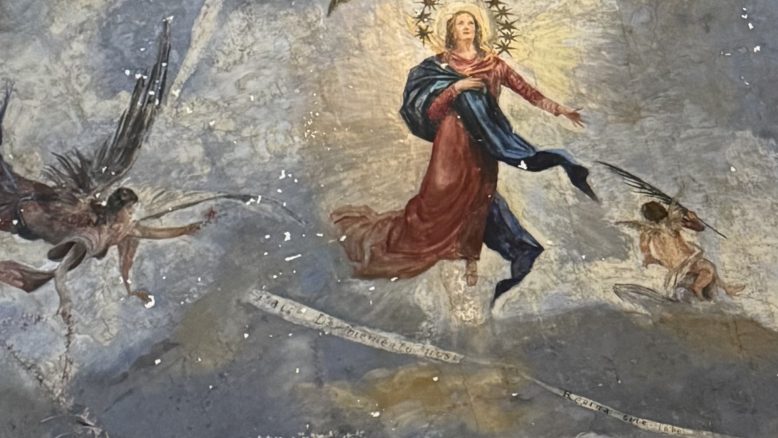
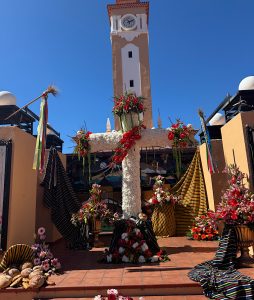
The repeated sounds of “Santa Cruz” appended to many Canary Island toponymic place names sent us on a quest. The military/religious symbol of the cross was used (as it might often be today) to mark a place on conquest and as an assertion that in this new world, this crossed land too, was declared acquired by the “divine right” of kings. Now the Spanish armada was no military slouch and in the mid 1650s it parked the cross of empire and outposts from Latin America to Mexico and even throughout the United States and into Canada. The planting of the Santa Cruz (Holy Cross) had little to do with holy and much to do with possession. A behavior that has marked invading cultures into our times. The celebration of Santa Cruz on May 3 in the Canary Islands is evidence of a Kingdom come. Decorated crosses throughout the Kingdom, yes Spain is still a Kingdom, are memorials to a long standing rule of might is right. The cross in Santa Cruz de Tenerife marks the market. Commerce celebrates a Kingdom come to overtake the barbarians some 250 years ago.
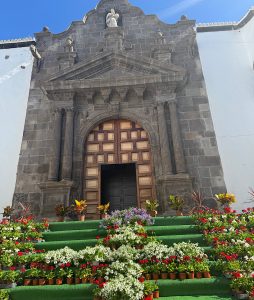
Then again in Santa Cruz de la Palma, the “Holy Cross” is celebrated on the steps of the church. The rule of the cross brought drinking water, a town council, a court house and civil obedience. In the generations from conquest to the present the rich have become richer and the Berbers are left seeking rights and righting history on the church steps.
Yet on the streets and in the monuments there is hope. The fishermen claim their traditional rights to the sea. The farmers are demanding a return of the cream of the crops. Might it be that the Holy Cross draped in tapestries and flowers has buried its grotesque nature in the greed of our conquest. Paste a cross on a building, neck or speech and it might rally support, win wars and capture assets, but it will remain an empty chunk of wood. Could holiness be saving crops, fish, lives and communities. There really is no “Santa” cruise!